
Free shipping on orders over $250
Simply, research peptides are any peptides that are used in scientific research. In recent years, peptides have gained recognition as being highly selective, potent, and effective in therapeutic applications, all while being relatively safe and well tolerated in study subjects and patients. Their ability to target specific receptors and trigger precise biological effects has made them a powerful tool for biomedical research.
As a result, there has been a significant increase in interest in peptides for pharmaceutical research and development. Scientists are exploring their potential to treat metabolic disorders, cancer, infectious diseases, inflammation, and rare conditions, among other areas. With the promising applications that peptides present for modern medicine, ongoing research, experimentation, and innovation are essential to unlock the next generation of pharmaceuticals and therapeutics.
Furthermore, peptides offer unique advantages over traditional small-molecule drugs. Their high specificity, low toxicity, and predictable metabolism make them attractive candidates for developing next-level therapeutics. This has led to a growing demand for research peptides to serve as the foundation for in-vitro experiments, helping researchers understand disease mechanisms, optimize drug targets, and develop novel peptide-based therapies.
Consequently, the surge in peptide research has created a dynamic and rapidly evolving field, driving both academic and industrial laboratories to explore new peptide sequences, modifications, and delivery methods. Research peptides are critical in this landscape, providing scientists with the tools needed to push the boundaries of medicine, biotechnology, and pharmaceutical innovation.

Over 7,000 naturally occurring peptides have been discovered. These peptides can often play vital roles in the human body as hormones, growth factors, neurotransmitters, ion channel ligands, and anti-infectives. Generally, peptides are effective and selective signaling molecules that bind to specific cell surface receptors, triggering intracellular effects. Additionally, in clinical trials, peptides have shown exceptional safety and tolerability in study subjects, while maintaining high selectivity and potency as well as a predictable metabolism. Consequently, peptides clearly present an enormous area of opportunity for therapeutic development.
Currently, the primary areas of disease fueling the research and use of peptide-based pharmaceuticals are metabolic diseases (such as type 2 diabetes) and oncology. The huge increases in obesity and type 2 diabetes in North America and other parts of the world have driven the development of peptide therapeutics for treatment of these conditions. Increases in cancer mortality and calls for alternatives to chemotherapy have spurred peptide research focused on oncological remedies. In addition, peptide research has expanded into the areas of infectious diseases, inflammation, and rare diseases. Research into peptides has also revealed excellent potential for their use in diagnostics and vaccination. Crucially, all of the research and study focused on unlocking the therapeutic potential of peptides for future medicines is reliant upon research peptides to serve as the basis for experimentation and development in the laboratory.
Importantly, research peptides are only made available for in-vitro study and experimentation. From the Latin for “in glass,” in-vitro refers to studies performed outside of the body. Hundreds of peptide therapeutics have been evaluated in clinical trials, and scientists and researchers around the globe are using research peptides in the lab to explore beyond the realm of traditional peptide design, pushing the boundaries to discover peptide variants that can be used as pharmaceuticals in the future. Already, there are over 60 peptide-based medicines on the market that have received approval from the US Food and Drug Administration (FDA). Among these are LupronTM, a treatment for prostate cancer, and VictozaTM, a treatment for type 2 diabetes. Both pharmaceuticals have achieved sales in the billions. However, it is essential to recognize that such FDA-approved drugs are NOT research peptides, they are just that: FDA-approved medications able to be prescribed by a healthcare professional for the treatment of a specific condition. Research peptides, on the other hand, are only intended for in-vitro study and research: they are not FDA approved for the treatment, prevention, or curing of any medical condition, disease, or ailment. Research peptides are those synthesized for study in the lab that can lead to new breakthroughs and future pharmaceuticals, but they become medicines only after undergoing rigorous study, clinical trial, and, crucially, the FDA approval process.
Whether your peptide research is in the pharmaceutical field, delves into the depths of biochemistry, or is focused on cosmetic applications, one thing is clear: the quality of the peptides used for experimentation is of paramount importance. Peptide research has fueled medical, pharmaceutical, and biochemical advancement across the globe, and it is vital that this research utilizes peptides that meet the most stringent quality control and purification standards. Experienced researchers worldwide know this – that’s why they demand peptides made in the USA.
Unlike peptides synthesized in many other parts of the world, American-made peptides such as those synthesized by r8virtualhealth.com are subject to rigorous and uncompromising manufacturing processes finely tuned to produce the most pure, highest quality peptides. As a result, researchers can rest assured that their studies and experiments will not be corrupted or skewed by impurities, fillers, or lower peptide content than claimed.
By choosing USA-made peptides, researchers also benefit from consistent batch-to-batch reliability, ensuring reproducible results across experiments. Our peptides undergo comprehensive analytical testing, including HPLC and Mass Spectrometry, to verify identity, purity, and integrity. Furthermore, our commitment to quality supports cutting-edge research and innovation, giving scientists the confidence to explore new therapeutic applications. It is clear that settling for anything less than USA-made peptides could put your valuable research in jeopardy and compromise the outcomes of critical studies.
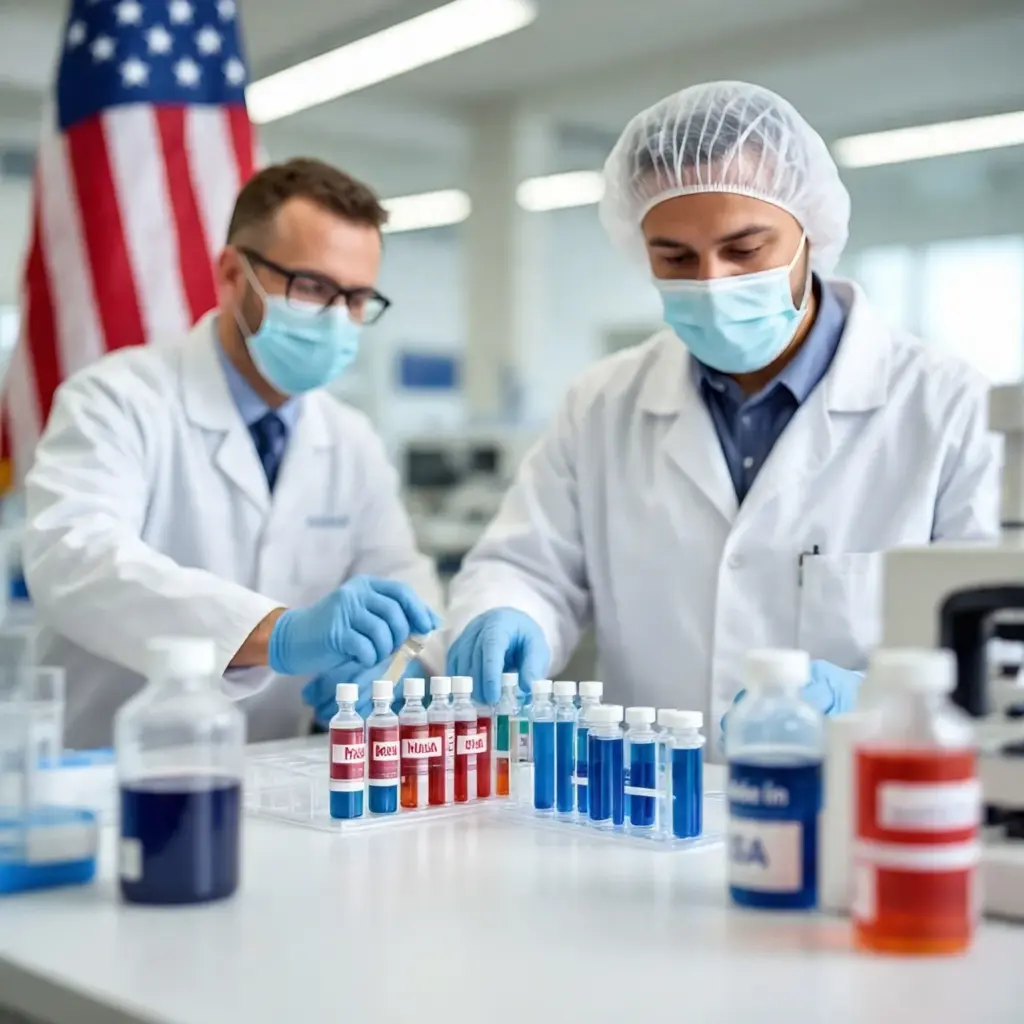
At r8virtualhealth.com, our U.S. made peptides are meticulously assessed and scrutinized at every level of the development and manufacturing processes. From the initial step of each peptide project to the final finishing stage, state-of-the-art analytical processes conducted by highly qualified peptide scientists ensure that purity and quality of the peptide is of the highest standard. Additionally, advanced solid phase peptide synthesis techniques coupled with cutting-edge cleavage and purification of the peptide post-synthesis allow our USA made peptides to be assessed at a level of quality fit for any manner of pharmaceutical study or biochemical application. Such uncompromising quality control is paramount to ensuring the purity of our peptides and the integrity of your research results.
The exacting production, manufacturing, purification, and analysis processes that peptides made in the US undergo assure peptide researchers that their peptides will be of the high standard necessary to ensure that research results are trustworthy and reliable. Such assurance is far preferable to non-USA made peptides that can be ridden with fillers used to cut manufacturing costs or impurities borne of substandard quality control. Any such peptide product not subjected to the rigorous production and manufacturing standards as those peptides made in the US may not be fit for laboratory research or any clinical application.
No matter if your peptide research is driven by biochemical study, pharmaceutical drug discovery, or any other laboratory use, one thing is clear – only trust USA made peptides.
At r8virtualhealth.com, we provide peptides that exceed 99% purity. Using state-of-the-art solution and solid phase peptide synthetic technology, R8 Virtual Health is able to offer the finest quality peptides and proteins fit for any research study or application. Peptide purity is achieved and verified through uncompromising manufacturing and production processes, quality control measures, and the implementation of both high-performance liquid chromatography and mass spectrometry analysis.
High performance liquid chromatography, or HPLC, is a scientific technique used to separate, identify, and quantify each component in a mixture. It is a superior process that allows highly accurate peptide testing to be accomplished. Mass spectrometry (MS) is a technique used to measure masses within a sample by ionizing chemical species and sorting the ions based on their mass to charge ratio. The results are plotted with the ion signal as a function of the mass to charge ratio. Both methods are highly accurate peptide testing techniques and scientifically prove the purity and identity of peptides ordered from r8virtualhealth.com.
R8 Virtual Health takes great pride in the quality of all of the products we manufacture, and we implement testing at all stages of peptide production at our peptide snythesis lab, verifying our peptides’ sequential fingerprints for precision accuracy in every preparation.

R8 Virtual Health provides only the highest purity peptides (>99% pure) for sale for research and development use. However, preparations of peptides synthesized for research by many other manufacturers can vary widely in purity. Occasionally, researchers can wonder what the minimum acceptable level of peptide purity is for their given purpose. Generally, the higher the peptide purity level, the more favorable the preparation; critically, for certain applications (such as in vitro studies or clinical trials), only exceedingly pure peptides will be appropriate (greater than 98% purity). However, there are some applications for which a lower peptide purity would be acceptable. The minimum recommended peptide purity level for a given application will therefore depend upon that specific application. Examples of minimum acceptable purity levels are as follows.
Those peptides with greater purity are appropriate for use in an application with a lower minimum acceptable level of purity. Peptide Sciences provides exceedingly high purity peptides that will meet or exceed all previously stated purity requirements.